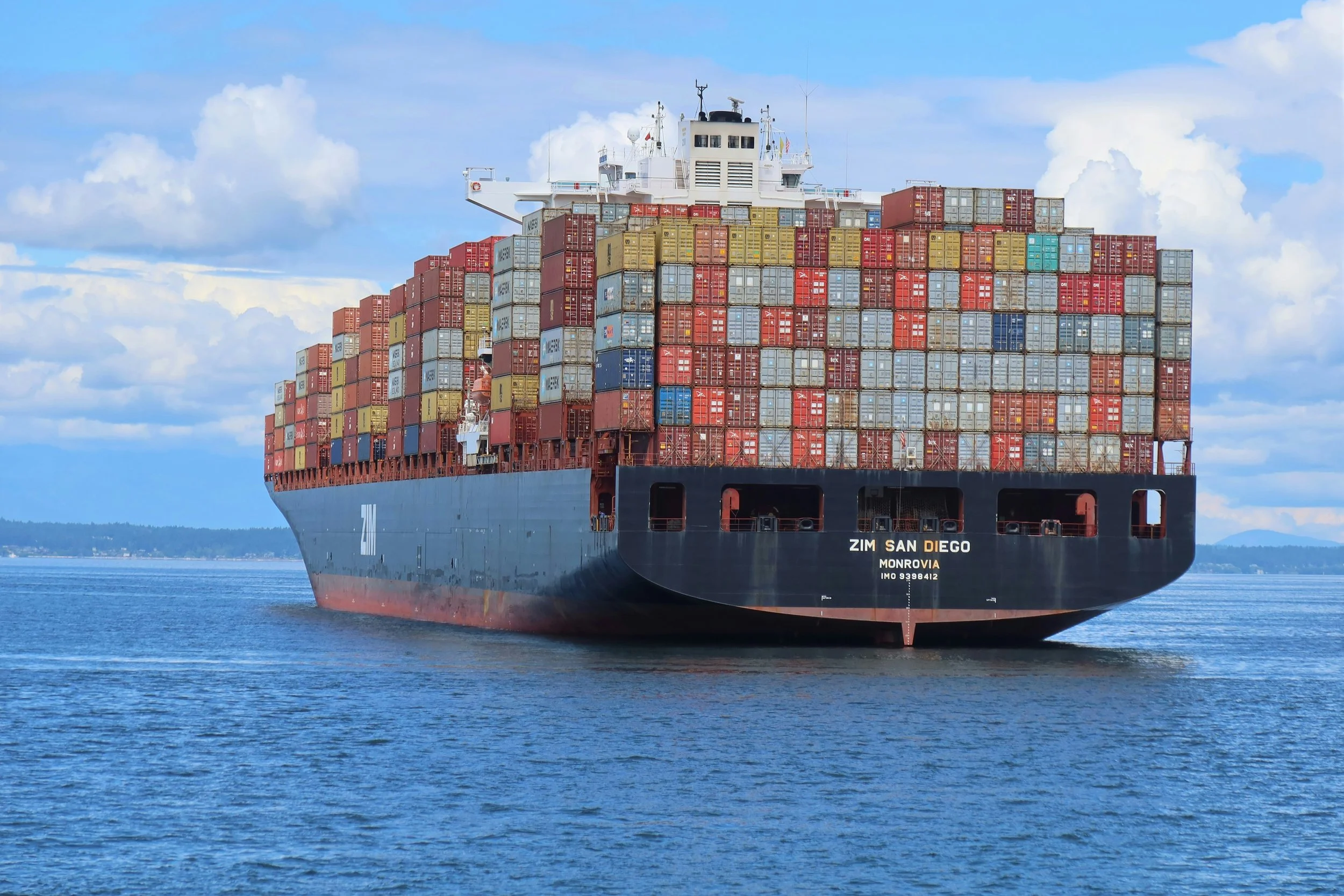
Unifying a Global Shipping Enterprise
ENTERPRISE UX
One Global Logistics
Unifying a global shipping enterprise — ocean, land, and air — through a single, AI-assisted application spanning the full quote-to-invoice workflow.
Need Headline
Need blurb
Roles:
Co-Lead, Brand Strategy & Human-Centered Design
User Researcher
Creative Director and Visual Designer
Responsibilities:
Co-led research-driven brand transformation, from insights to final identity
Synthesized stakeholder research into strategic direction
Co-facilitated alignment across staff, leadership, and board
Led naming strategy and validation process
Defined brand positioning, voice, and messaging
Designed visual identity system and supporting assets
Created brand guidelines for scalable rollout and adoption
Timeframe:
Phase 1: 5 months in Q3-Q4 2025
Overview
Our client is a family of transportation and logistics companies operating across ocean, land, and air — connecting domestic and international markets across Alaska, the Pacific Northwest, Hawaii, and beyond. Despite sharing a parent organization, each business unit ran on its own tools, processes, and institutional knowledge, creating deep operational silos and a fragmented experience for employees and customers alike.
This modernization effort is the product of two years of preparation by the client's IT organization — a deliberate migration from legacy infrastructure to cloud-native systems on Microsoft Azure. It is also the opening chapter of an ambitious ten-year transformation roadmap. Our engagement as design partners marks the moment the strategy became something people could see, touch, and test.
Caption
The Opportunity
Multiple business units. Dozens of disconnected legacy applications. Customer Service Representatives managing quotes, bookings, shipments, and invoices — juggling fragmented tools while holding critical process knowledge entirely in their heads. The cost wasn't just operational; it was human.
The client's IT transformation presented a rare window. Our mandate for Phase 1: take the substantial research the client team had already conducted over two years, synthesize it into a coherent design vision, and deliver a working prototype validated enough to greenlight Phase 2 — with AI embedded not just in the design process, but in the product itself.
“Every time we quote something, we gamble.”
Pain Points
Outdated, manual, and fragmented systems across business units
Repetitive data entry creating errors and wasted time
Complex pricing and routing rules with no embedded decision support
International and domestic operations managed in isolation, with no integration
Import rates and third-party logistics data requiring manual outreach to agents
No real-time shipment or workflow visibility across service centers
Tribal knowledge gaps — expertise locked in individuals, not systems
High cognitive load on Customer Service Representatives
Approach
We ran a full-day human-centered design sprint, grounding every decision in field research and moving rapidly from insight to testable prototype, validating with users every few weeks.
AI was threaded through the entire process — accelerating synthesis, generating prototype complexity, and ultimately living inside the product as an intelligent assistant.
Research & Insights
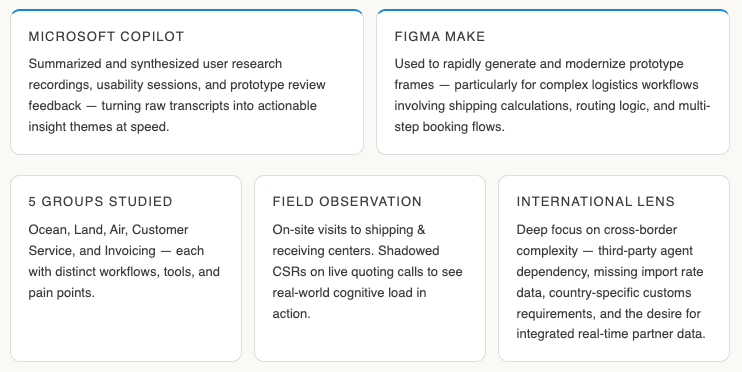
We spent time in the field across five logistics groups — observing, listening, and mapping. We visited shipping and receiving sites to watch drop-ship flows firsthand, and sat alongside Customer Service Representatives as they handled live quoting calls. International operations were a particularly revealing lens: teams were relying on agents in remote regions of the world to supply import rates on demand, and opening multiple third-party applications just to answer a single customer question.
To accelerate synthesis without sacrificing depth, we used Microsoft Copilot to process and summarize research call recordings and prototype review sessions — compressing hours of transcripts into structured insight clusters and freeing the team for analysis rather than documentation.
A consistent theme across every group: the system made people do its thinking for it. CSRs held complex pricing rules, routing constraints, and exception logic entirely in memory — undocumented, inconsistent, and always one departure away from being lost entirely. International teams expressed it most directly: they wanted strategic recommendations built into the workflow, surfaced from inputs and historical data rather than accumulated personally over years.
Strategy & Alignment
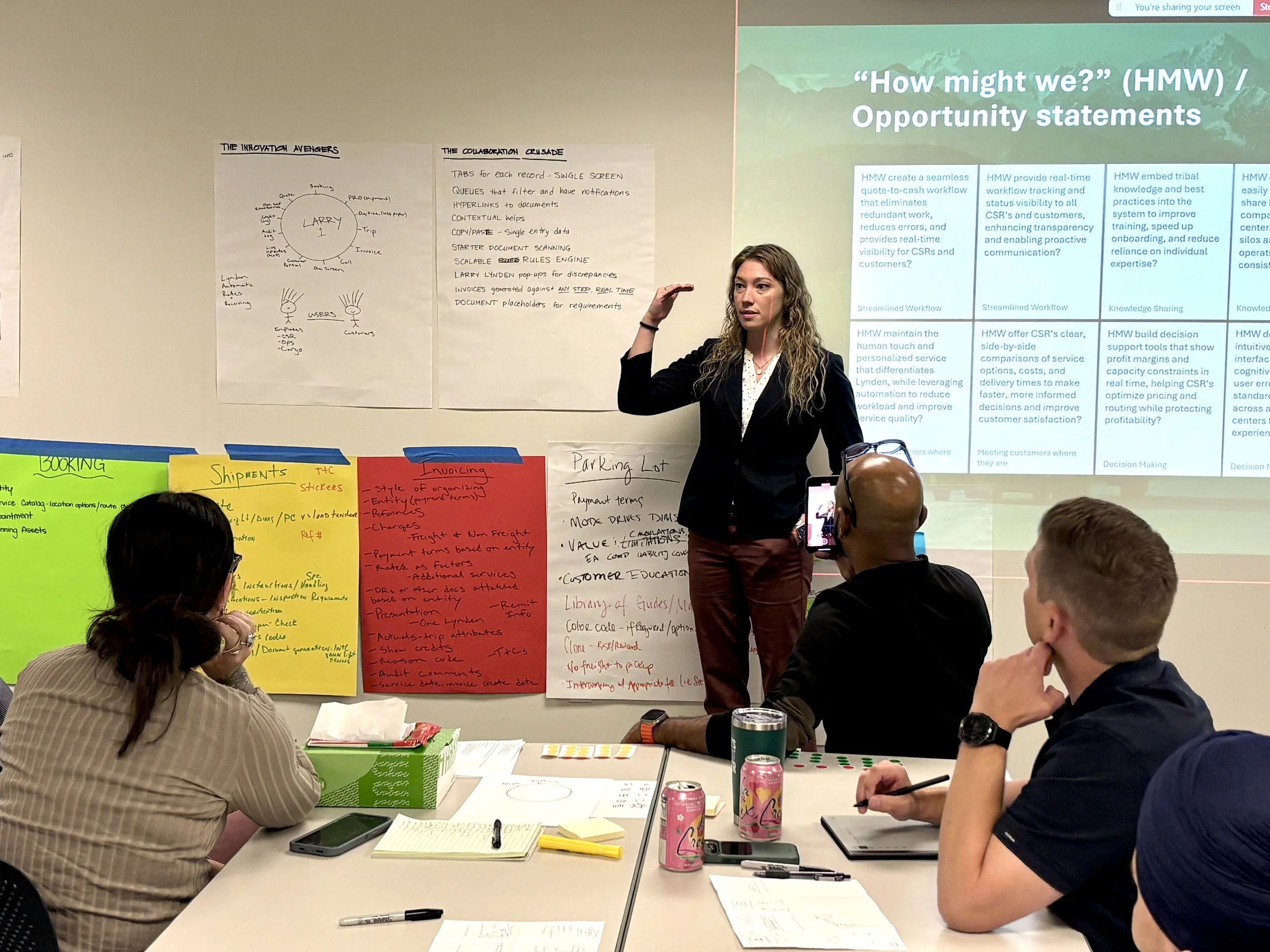
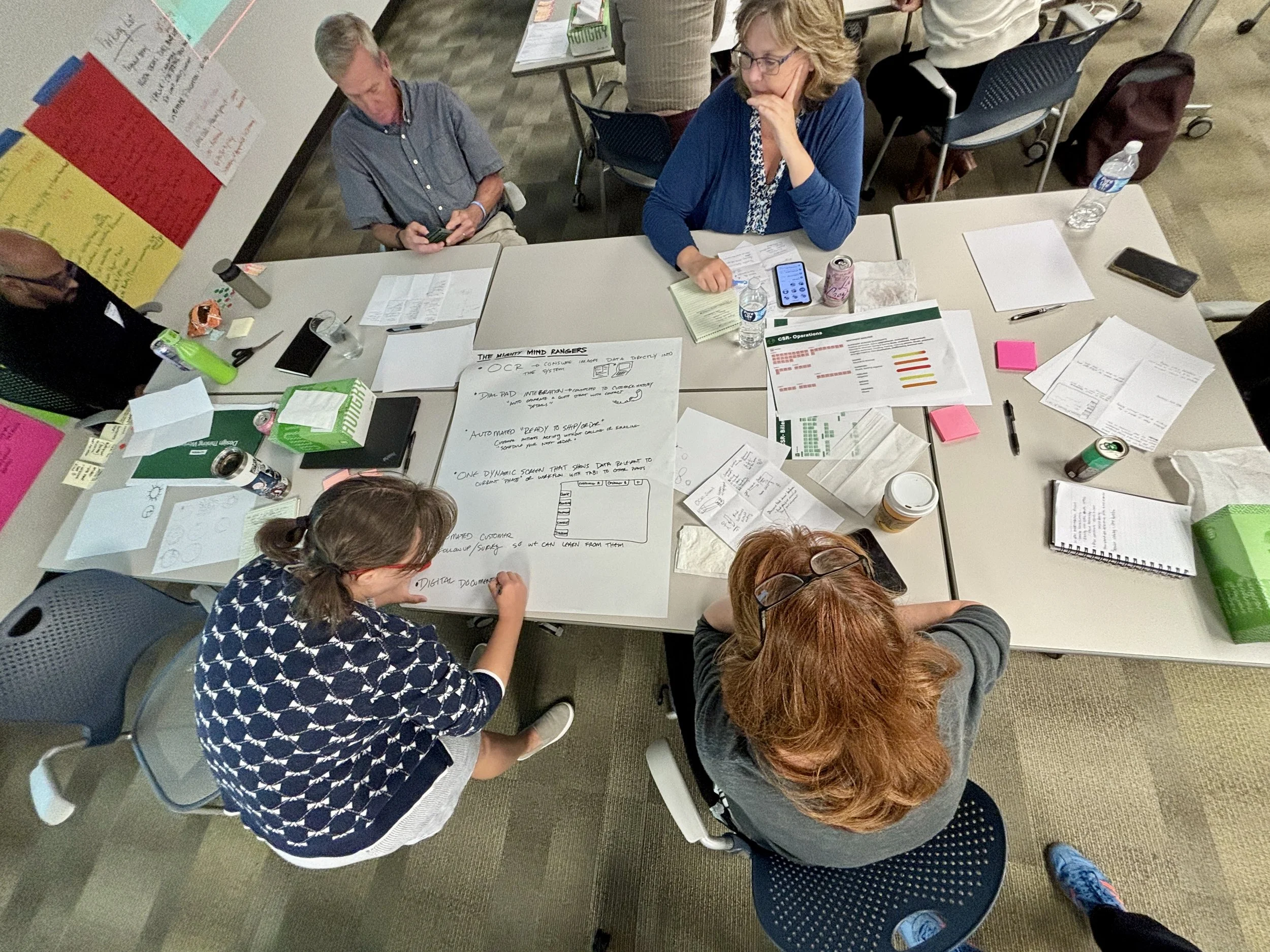
We ran a multi-day Design Thinking Workshop with stakeholders spanning Sales, Shipping, Invoicing, Booking, Quoting, IT, and Logistics. The goal was to build shared ownership of the problem and solution direction — not to present findings and move on.
Research validation & empathy review
Walked the full group through field findings, empathy maps, and sentiment analysis. Stakeholders confirmed, challenged, and enriched what we'd observed — particularly around international operations and third-party integration pain points.
‘How Might We’ framing
HMW statements across six themes — Streamlined Workflow, Knowledge Sharing, Decision Making, Training, Notifications, and Meeting Customers Where They Are — structured the challenge space and surfaced productive tensions between automation and human judgment.
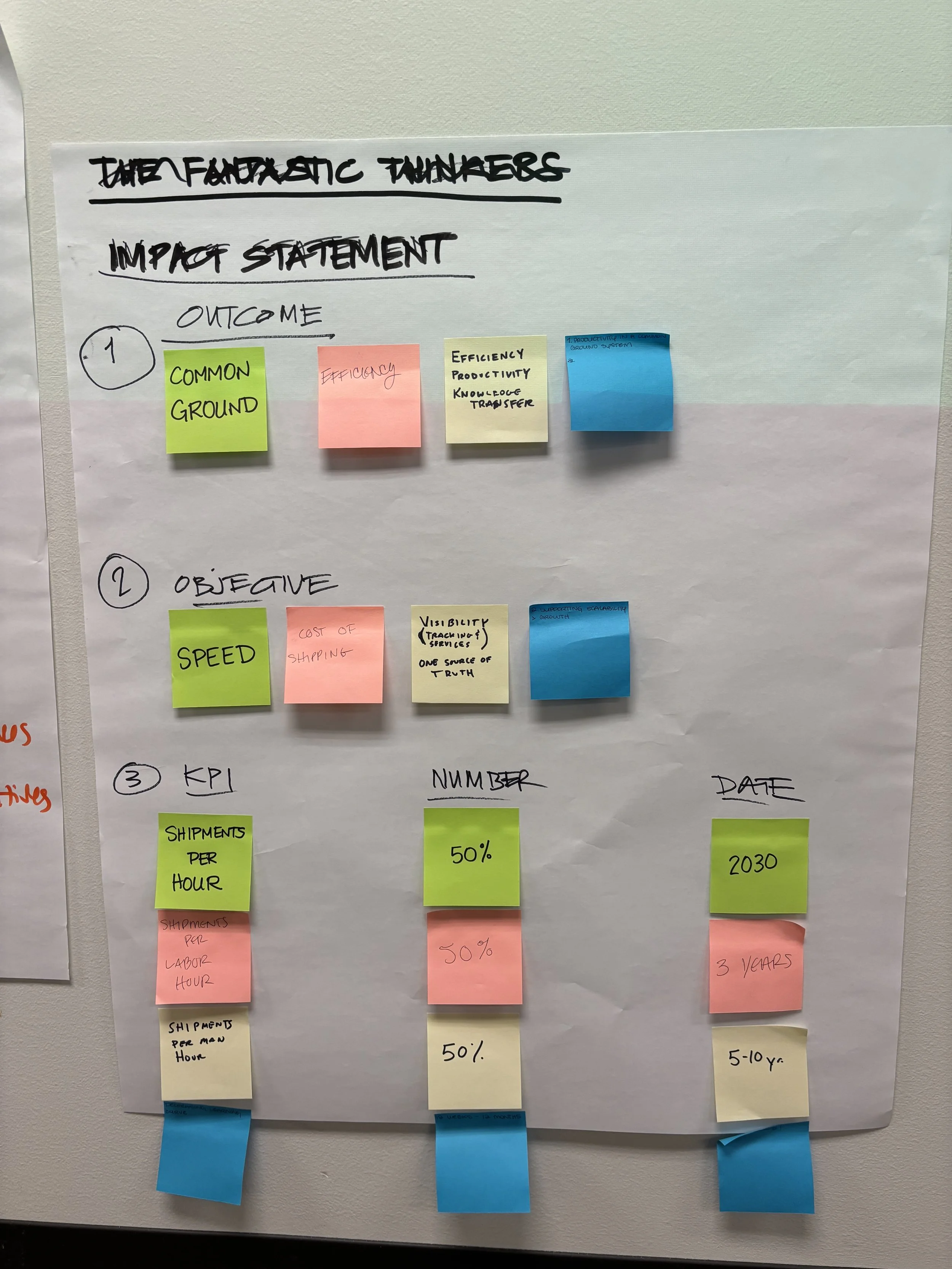
Defining success metrics
Rather than chasing features, we collectively defined what customer and business success looked like — and what we'd actually measure. Outcomes over outputs, from the start.
Cross-industry inspiration & Crazy 8s
Participants explored adjacent industries solving similar problems. Individual sketching before group synthesis kept ideas divergent before converging — generating unexpected parallels between logistics and other real-time decision-making domains.
Storyboarding & dot voting
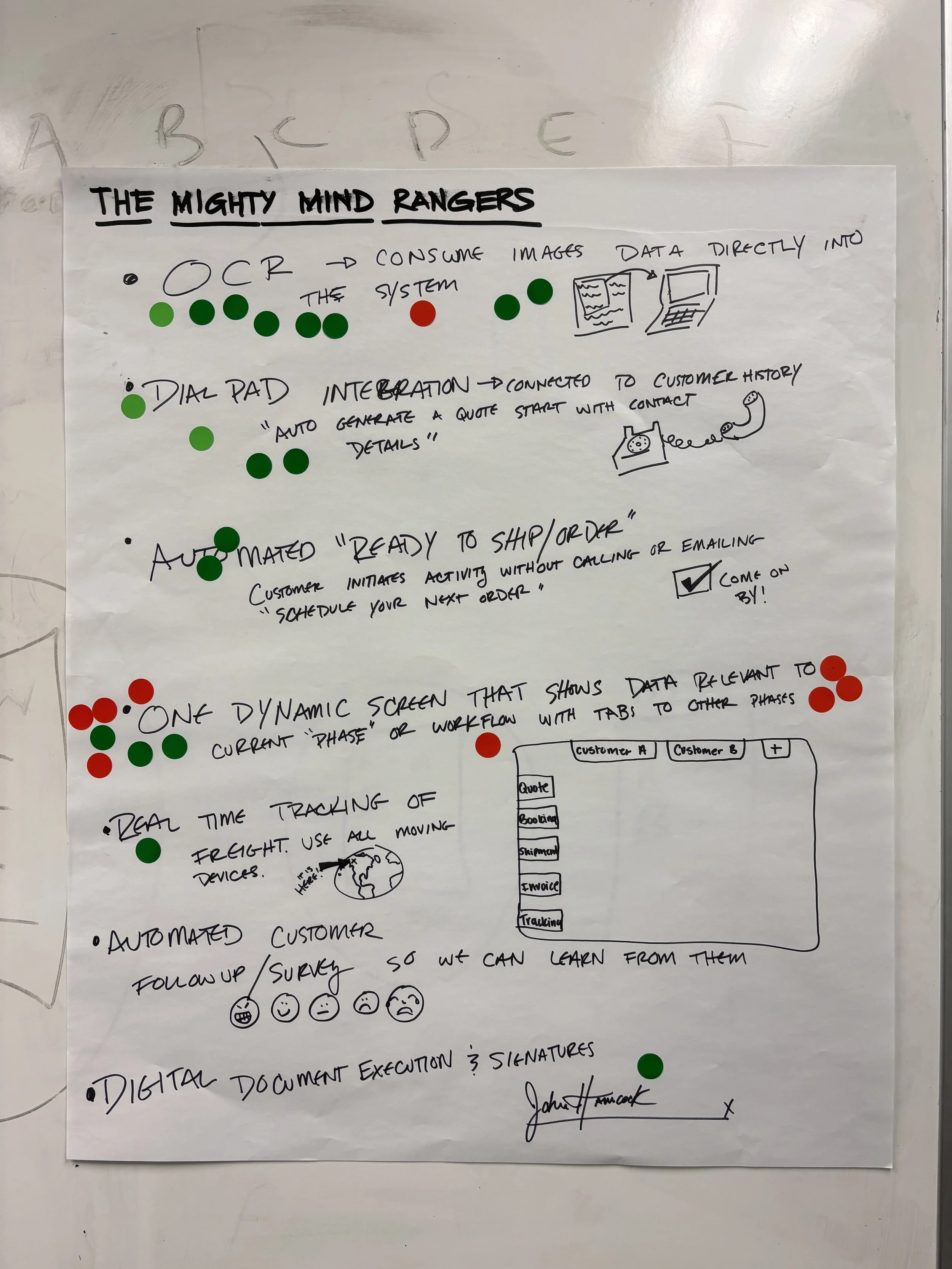
Small pods built multi-panel storyboards of their best ideas, presented to the group, and surfaced the assumptions each concept relied on. Dot voting prioritized sprint focus areas and exposed the team's hidden consensus.
How Might We…?
Streamline Our Workflows
How might we create a seamless quote-to-cash workflow that eliminates redundant work, reduces errors, and provides real-time visibility for CSRs and customers?
Make Decisions
How might we build decision support tools that show profit margins and capacity constraints in real time, helping CSRs optimize pricing and routing while protecting profitability?
Knowledge Share
How might we embed tribal knowledge and best practices into the system to improve training, speed up onboarding, and reduce reliance on individual expertise?
Rapid Prototyping & Agentic Design
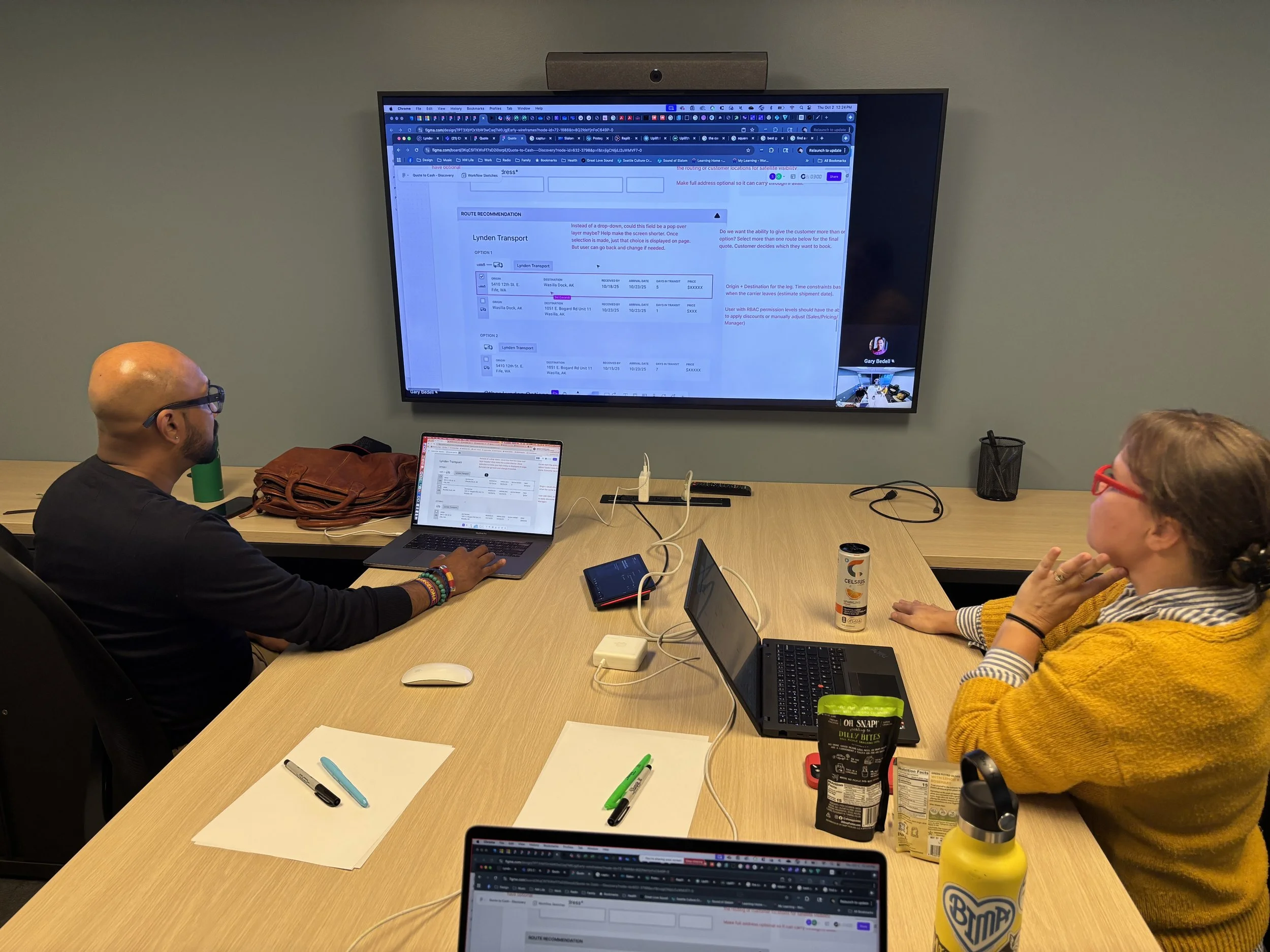
With the workshop's priorities established, we mapped key workflows in FigJam — laying out the end-to-end flows we needed to build and test before any design work began. This gave the team a shared visual language for the experience and surfaced sequencing decisions early, when they were cheap to resolve.
From those workflow maps, we developed rudimentary wireframes to establish the foundational architecture of the application: navigation structure, information hierarchy, key components, and layout logic across the core modules. Wireframes weren't a formality — they were the structural scaffolding that everything else was built on.
We then brought those wireframes into Figma Make, using AI generation to modernize the visual language, bring the interaction concepts to life with working calculations, and accelerate the development of complex logistics workflows that would have taken weeks to build by hand. The result was a high-fidelity, interactive prototype ready for real user testing in a fraction of the usual time.
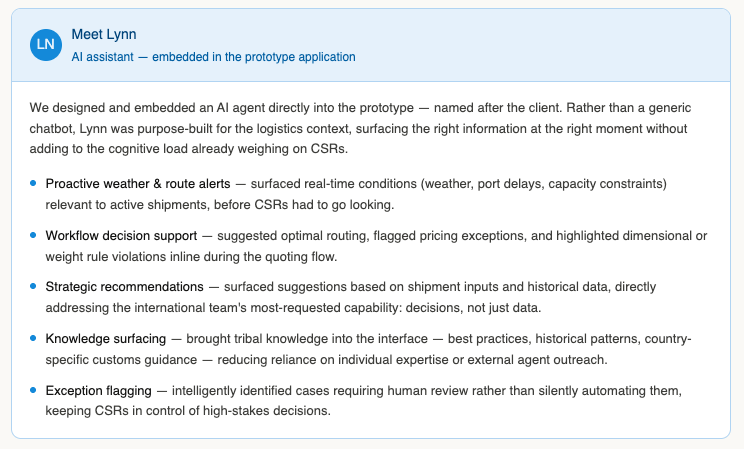
Lynn wasn't designed to replace CSR judgment, she was designed to amplify it. Giving the agent a distinct name and identity helped users during testing form a relationship with the assistant, provide more specific feedback, and think of AI assistance as a teammate rather than a feature. That reframing — from tool to collaborator — measurably changed how users engaged with the prototype.
Key Screens & Flows
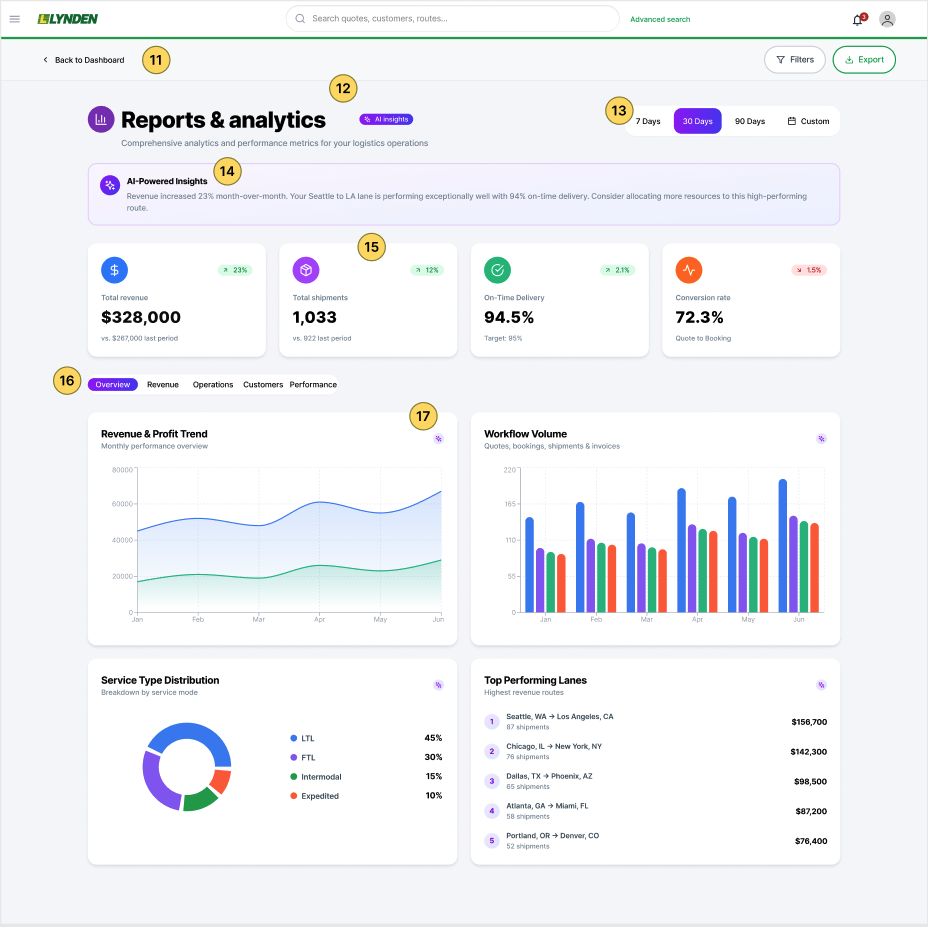
The prototype covered the full quote-to-invoice workflow across five business units. Beyond the core transactional flows, three additional surface areas were critical to the day-to-day experience of every CSR..
Role-Based Home Screen
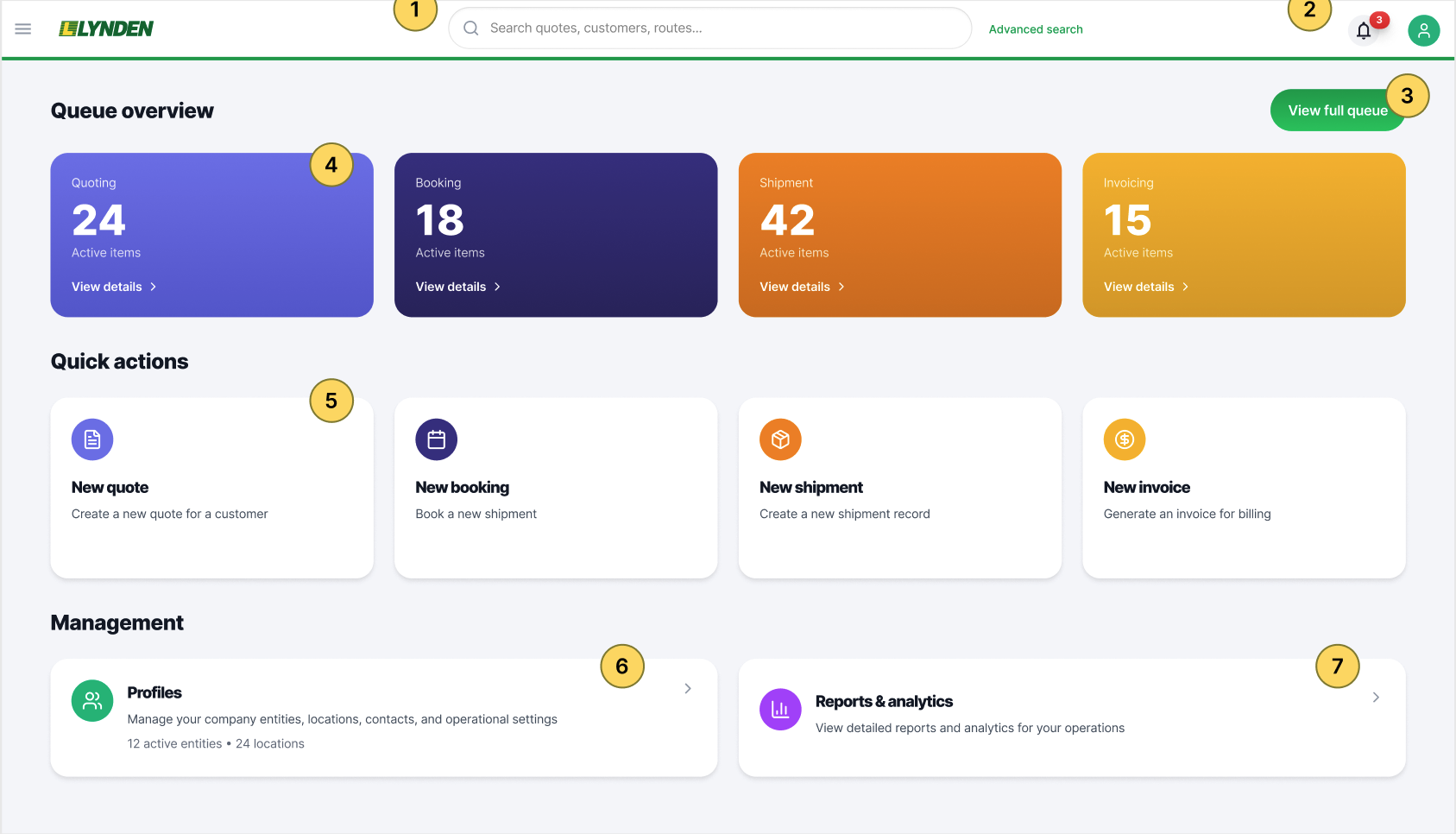
A personalized landing page that orients each user to their day. Surfaced role-relevant metrics and data dashboards, and served as the launching point for any workflow — Quoting, Booking, Shipping, or Invoicing — with Lynn's contextual insights visible from the moment users arrived.
Work Queue
A filterable table listing every active record — orders and shipments — assigned to the individual user. Showed real-time progress and status at a glance. From the Queue, CSRs could jump directly into an in-progress record, complete remaining tasks, see management approvals, and act on pending notifications — one place for everything that needed attention.
Core Workflow — Quoting to Invoicing
The primary end-to-end flow: quote creation, booking, shipment receiving, and invoicing — unified across Ocean, Land, and Air for the first time. Lynn provided inline guidance and decision support throughout, with side-by-side service comparisons, real-time pricing, and exception flagging baked into each step.
Customer Master Records
A unified database of all customers and shipping partners — customer IDs, address locations, key contacts, order history, preferences, notes, and parent/child associations for larger accounts. Integrated with the client's existing Workday system. The Customer Master was also designated as the first screen set to be built in Phase 2, making its design particularly critical to get right.
Documentation & Annotations
Before the pattern library was built, we created a robust documentation layer in FigJam — a comprehensive site of annotated workflow compositions covering every new and combined feature in the application.
This wasn't boilerplate spec documentation. It captured the design team's thinking on how the system worked, how Lynn intervened at crucial decision-making points in each workflow, and what logic governed her suggestions. It gave engineers the functional and behavioral context they needed to build Lynn accurately — and gave stakeholders and future users a clear picture of what the newly connected system was capable of.
We also used the documentation to close the loop with each division of the company — mapping their highest-priority requests to the solutions we'd designed. Users could see that we'd listened. Their pain points weren't acknowledged and filed away; they were addressed, integrated, and explained in context. That visibility mattered for buy-in as much as the prototype itself.
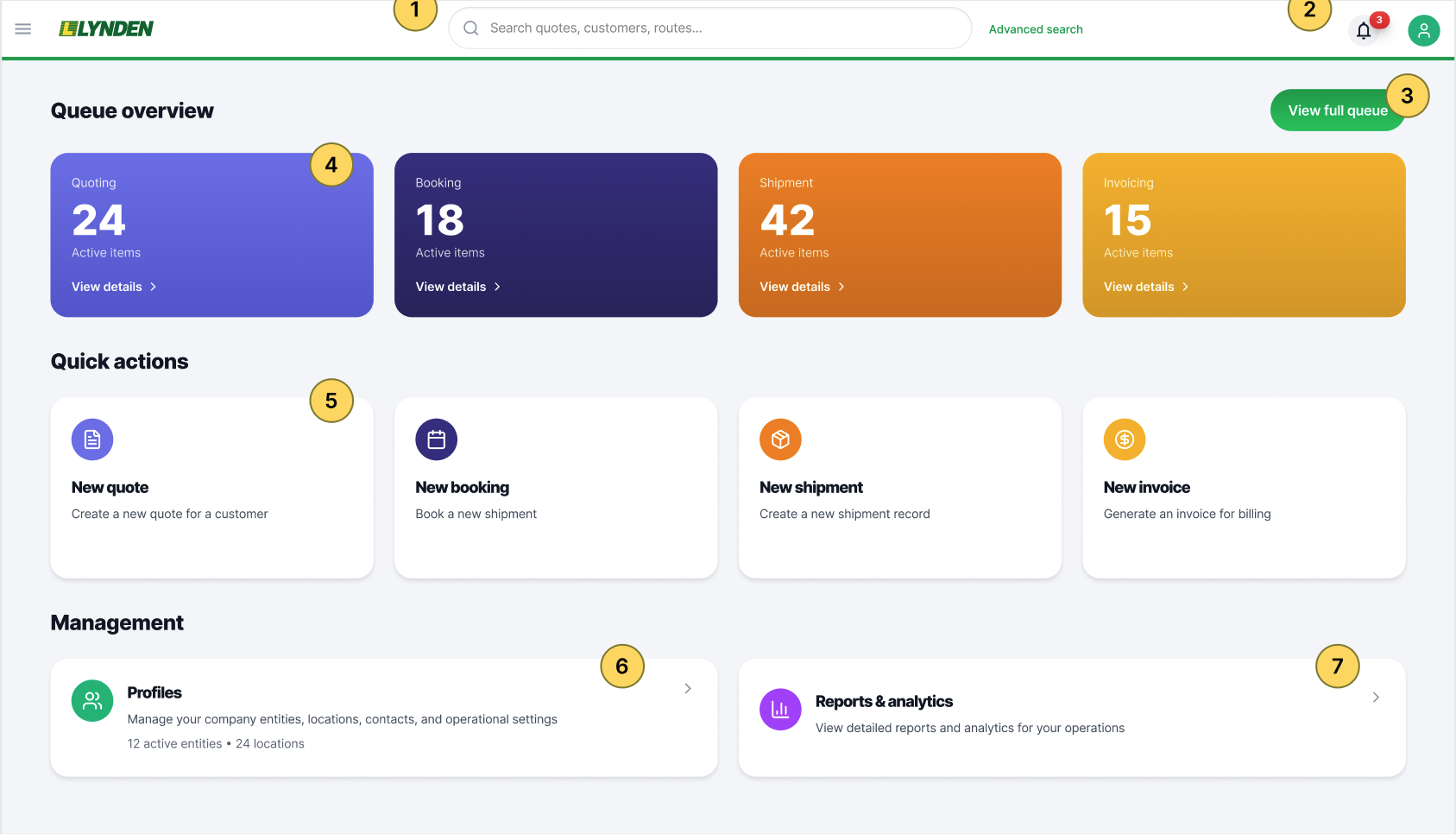
For Engineers
Lynn's function and logic documented in detail — behavioral rules, decision triggers, exception thresholds, and integration points — reducing ambiguity before a single line of code was written.
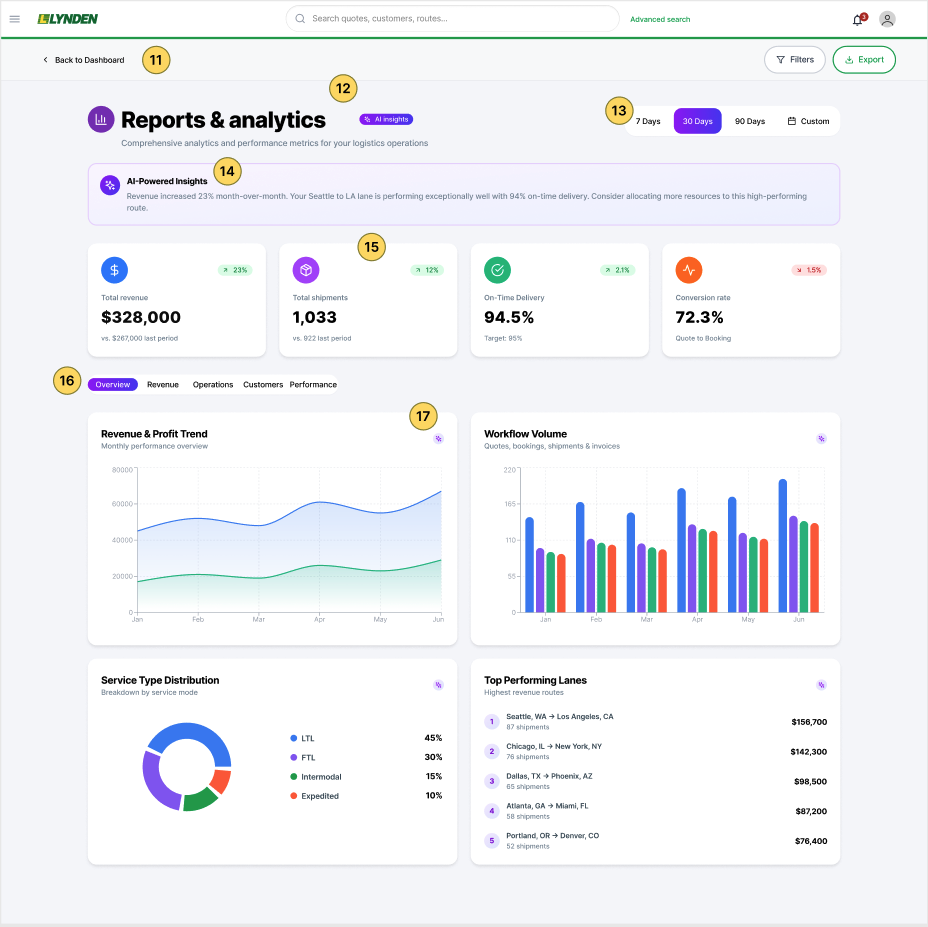
For Stakeholders & Users
An overview of the system's new capabilities, mapped to the specific asks each division raised during research — demonstrating that priorities were heard and integrated, not deprioritized.
Base Design System & Pattern Library
As the prototype stabilized, we extracted its patterns into a foundational pattern library spanning the full application — Home, Work Queue, the Quote-to-Invoice workflow, and Customer Master. Every component has a user-validated origin: tested against real workflows, not designed in the abstract.
For Phase 2, the team made a deliberate sequencing decision: the Customer Master screens would be the first to be built in code using the proposed design system. Their relative structural consistency and high data density made them an ideal proving ground for the component library — a focused first build that stress-tests the system before the more complex transactional flows are implemented.
For Engineers
Navigation, forms, data tables, status indicators, notification components, and Lynn's interaction model — all derived from real prototype usage.
Phase 2 First Build
Customer Master screens designated as the first code implementation — a deliberate choice to validate the design system on a structured, data-rich surface before tackling complex transactional flows.
Unified Visual Language
One component set for Ocean, Land, and Air — applied consistently across all modules, establishing the visual foundation of the ten-year roadmap.
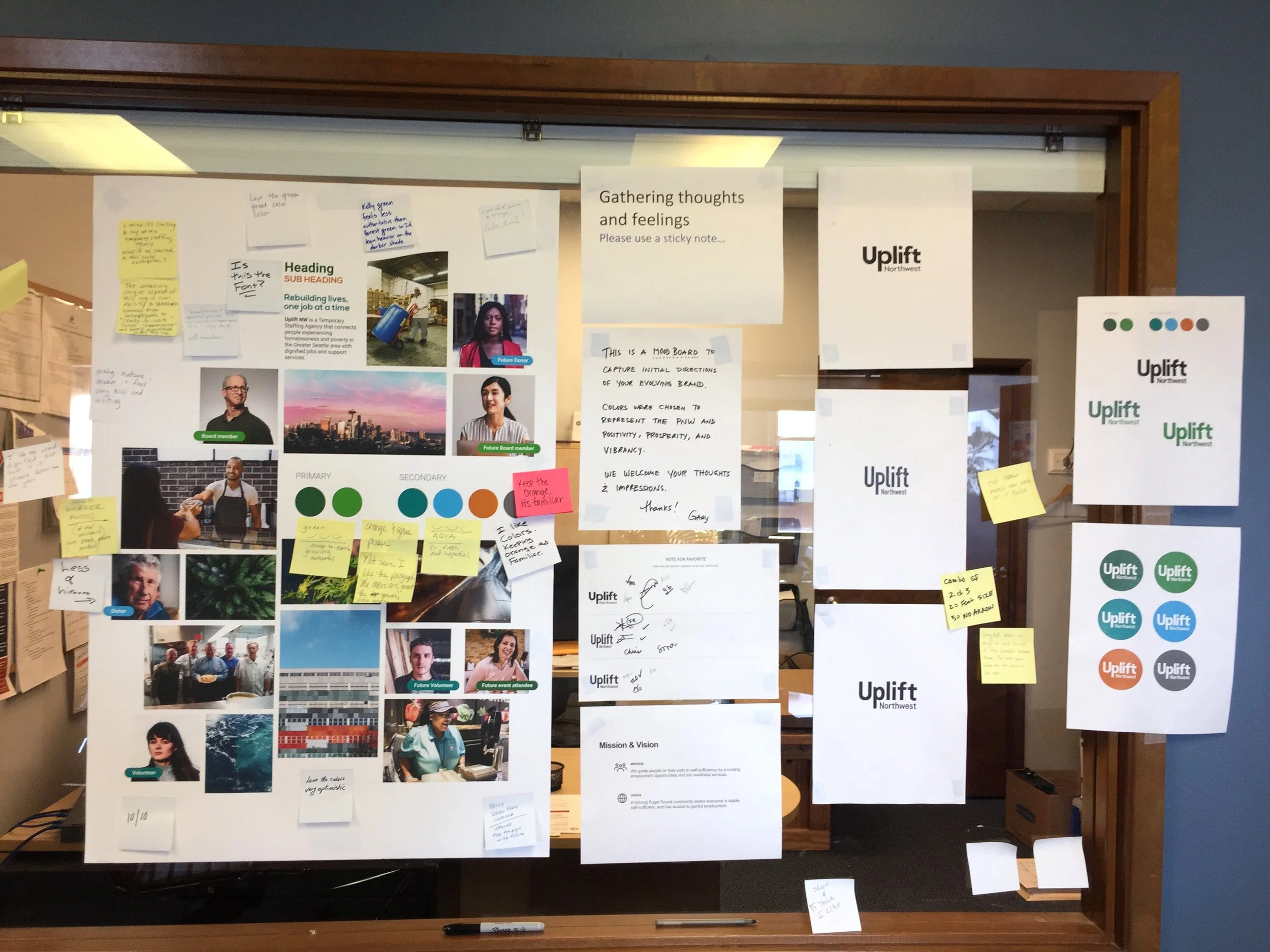
Mood board and logo iterations were posted in a common area for the charity’s employees to weigh in on. They appreciated being part of the process.
Impact & Outcomes
Phase 1 delivered a validated, high-fidelity prototype — spanning the full quote-to-invoice workflow, with an embedded AI assistant, a role-based home screen, a unified work queue, and a complete customer master — ready for broader testing and stakeholder review. It is the first tangible artifact of a ten-year transformation.
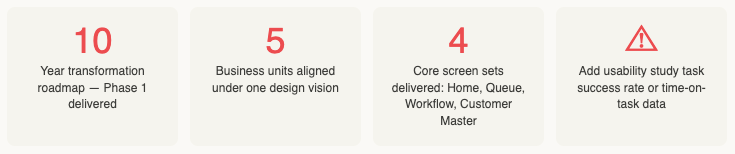
Beyond the prototype, the documentation and workshop process shifted how the client team talked about the problem — from feature requests to outcomes. The introduction of Lynn sparked a broader conversation at the organization about where AI belongs in their future operations, a conversation that wasn't on the original agenda but that now has a place in the ten-year roadmap.
Key Learnings
AI in the process is a multiplier, not a shortcut.
Using Copilot for research synthesis and Figma Make for prototype generation didn't reduce the design work — it redirected it toward higher-value decisions. Time not spent on documentation and scaffolding went into testing and iteration instead.
Tribal knowledge is a design problem, not a training problem.
The single biggest insight from research: critical operational knowledge lived entirely in people's heads. The answer wasn't better onboarding — it was designing systems (and an AI agent) that surface and encode that knowledge in the moment it's needed.
Identity changes how people relate to AI.
Naming the agent and giving her a distinct purpose fundamentally changed how users engaged during testing. Participants gave more specific, actionable feedback and treated Lynn as a collaborator rather than a feature. A small naming decision with a measurable effect on research quality.
Documentation is a design deliverable.
The FigJam documentation site wasn't a handoff artifact — it was a trust-building tool. Showing each division exactly how their priorities were addressed turned stakeholders into advocates and gave engineers the clarity to build confidently.
Wireframes and workflow maps earn their cost.
Mapping flows in FigJam and building wireframes before opening Figma Make resolved structural decisions early, when they were cheap — and gave the AI-assisted generation phase a much cleaner brief to work from.
Automation and human judgment are a spectrum, not a trade-off.
Users were most receptive to AI assistance when it supported their decisions rather than replacing them. Lynn's most effective moments were flagging exceptions for human review — not resolving them silently. Trust was built through transparency, not just capability.
Reflections
I feel fortunate to have been brought into this project. From day one, I was pleased to see how much planning and preparation our client did before this phase was activated. The Global Logistics IT department has spent the last two years strategically planning and executing on their modernization plan. They are ready. People are looking forward to a more unified business experience in all departments. Champions and leads have been identified. Desires heard, priorities set. The roadmap is lengthy, and their mindset for growth and evolution is aiming for the horizon ahead.